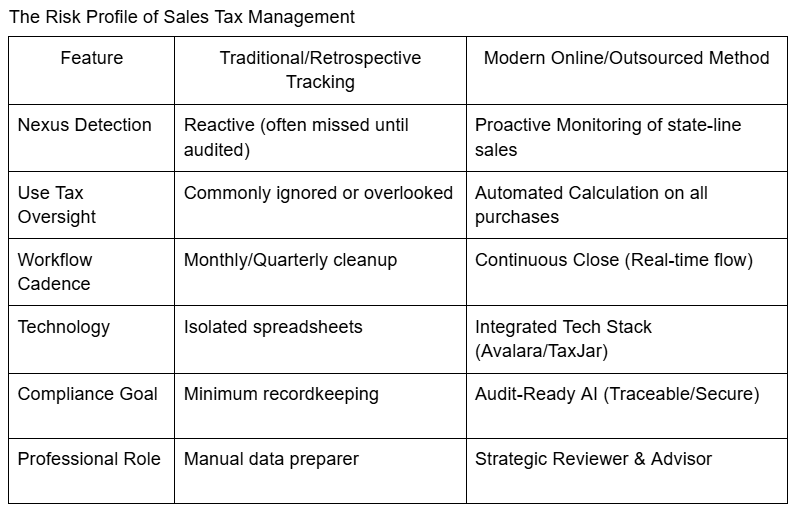
A significant pitfall in modern business operations is treating sales tax as a secondary concern, often focusing exclusively on income and payroll taxes. This error is most common among businesses selling physical or digital goods across state lines, where a company may unknowingly establish a sales tax nexus. Failing to register, collect, and remit these taxes can result in a devastating accumulation of back taxes, penalties, and interest. Furthermore, many founders overlook use tax, which is owed on purchases when a vendor fails to charge sales tax to the end user. Without a proactive system, these obligations are often only discovered during a moment of cash-flow stress or a formal audit.
Utilizing outside and online bookkeeping services provides a strategic shield against these liabilities by implementing an integrated tech stack designed for compliance. These virtual firms act as strategic reviewers, leveraging specialized accounting knowledge to navigate shifting 2026 regulations and tax code sunsets. By moving toward a continuous close model, where automated systems reconcile data in real-time, sales tax liabilities are tracked daily rather than during a frantic month-end "fire drill". This ensures that tax exposure is identified early, transforming tax management from a retrospective chore into an ongoing operating habit.
The evolution of financial management has introduced "Audit-Ready AI"—systems engineered to be transparent and traceable to satisfy board-level and regulatory scrutiny. Proactive AI agents, such as an Accounting Agent, can now handle high-volume transaction matching and anomaly detection to flag tax inconsistencies automatically. This digital transformation allows the professional to pivot from manual data entry to providing high-level financial storytelling and strategic guidance. Ultimately, by establishing a single source of truth in the cloud, businesses can ensure their records remain accurate, secure, and fully compliant with the complex landscape of 2026 financial mandates.