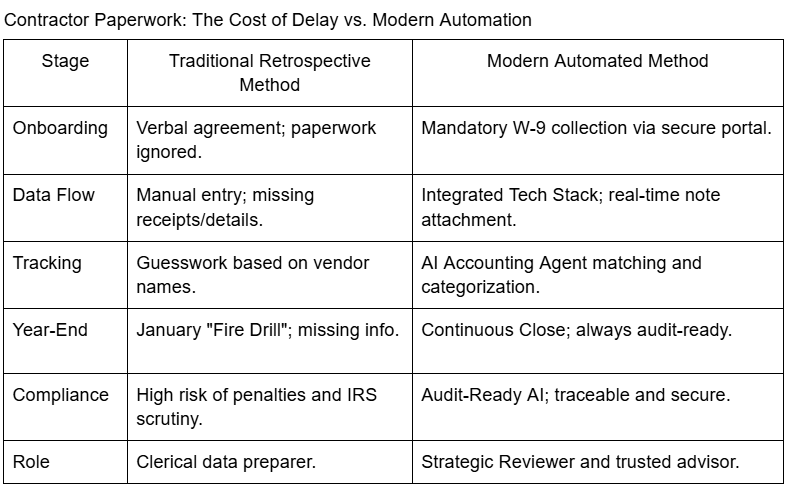
A common error in small business management is treating contractor documentation as a retrospective task rather than an ongoing operating habit. Many founders pay contractors for months before realizing they never collected a W-9 form, leading to a stressful, manual scramble in January to confirm tax details and reconstruct payment histories. This oversight creates significant compliance risk and the potential for IRS penalties, as a 1099 form must be issued for any contractor paid more than $600 in a single tax year to properly substantiate business expenses. Failing to collect this paperwork upfront removes the "context" of the transaction, forcing bookkeepers to guess at details and potentially delaying the month-end close beyond the critical 15-day mark.
Utilizing outside and online bookkeeping services effectively mitigates these risks through a robust integrated tech stack. These virtual firms leverage secure client portals to automate document requests and reminders, ensuring that vital forms are collected at the point of onboarding rather than at year-end. This remote partnership provides a single source of truth regarding contractor status, allowing leadership to focus on core business mission while their trusted advisor leverages specialized accounting knowledge to navigate shifting 2026 regulations and payroll transparency laws. Furthermore, these services often provide superior data security through SOC II certified environments, protecting sensitive contractor Social Insurance Numbers more effectively than typical in-house systems.
Modern financial management is evolving toward a continuous close model, where proactive AI agents—specifically the Accounting Agent—automate high-volume workflows like transaction matching and automated evidence collection. This digital transformation elevates the professional's role from a manual "preparer" to a strategic reviewer who focuses on judgment and financial storytelling rather than clerical "ticking and tying". By embedding automated W-9 collection and 1099 tracking into the daily digital workflow, firms maintain "Audit-Ready AI" systems that satisfy board-level scrutiny and ensure every transaction is traceable and compliant in real-time.